Before Uganda’s newest airport welcomes its first passenger, before a truck drives along a newly paved highway, and before a factory opens its gates, something extraordinary happens behind the scenes.
Long before the ribbon-cutting ceremonies, government announcements, and newspaper headlines, fleets of heavy equipment were already transforming untouched land into the foundations of the nation’s future.
Every scoop of an excavator, every pass of a motor grader, every lift of a mobile crane, and every load carried by a wheel loader is part of a much bigger story.
In 2026, Uganda’s biggest construction projects are doing far more than changing skylines and transport networks.
They are creating unprecedented demand for skilled heavy equipment operators and proving just how essential heavy equipment has become to the country’s development.
If you’ve ever wondered how these ambitious projects become realities, the answer is surprisingly simple; it all starts with the heavy machines.
Across Uganda, billions of shillings continue to be invested in transport infrastructure, industrial parks, energy facilities, oil and gas developments, and urban expansion.
While these projects differ in size and purpose, they all have one thing in common. They rely on heavy equipment to transform engineering drawings into reality.
From the first day a construction site is surveyed until the final inspection is completed, heavy equipment performs the demanding work that makes modern construction possible.
These powerful machines excavate, lift, transport, compact, grade, and prepare construction sites with remarkable speed and precision, allowing projects that once took years to be completed in far shorter timeframes.
Behind every machine is a skilled operator making hundreds of critical decisions each day. Every movement of an excavator bucket, every perfectly graded road surface, and every safely lifted steel beam reflects the experience and professionalism of operators.
As Uganda continues building for the future, understanding the role of these machines offers a completely new perspective on the country’s biggest infrastructure projects.
The machines building Uganda’s future
Take a moment to imagine a modern highway, an international airport, or a large industrial park before construction begins. Instead of smooth roads and towering buildings, there is untouched land waiting to be transformed.
Before concrete mixers arrive or steel structures begin rising into the sky, construction sites come alive with powerful machines performing the groundwork that makes everything else possible.
This is where the real story of Uganda’s infrastructure boom begins. Every successful project follows a carefully planned sequence of operations, and every stage depends on the right machine arriving at the right time.
Some machines break ground, others shape the terrain, while others transport materials or lift structures weighing several tonnes. Remove just one of these machines from the process, and an entire project can slow to a halt.
Whether it is Hoima International Airport, road expansion programmes connecting districts, industrial parks supporting manufacturing, hydropower developments, or infrastructure linked to Uganda’s oil and gas sector, these projects share one invisible workforce.
It is not made up only of engineers or construction workers, but of powerful machines operating continuously to keep progress moving forward.
Here are the heavy equipment behind the construction projects in Uganda
Excavators
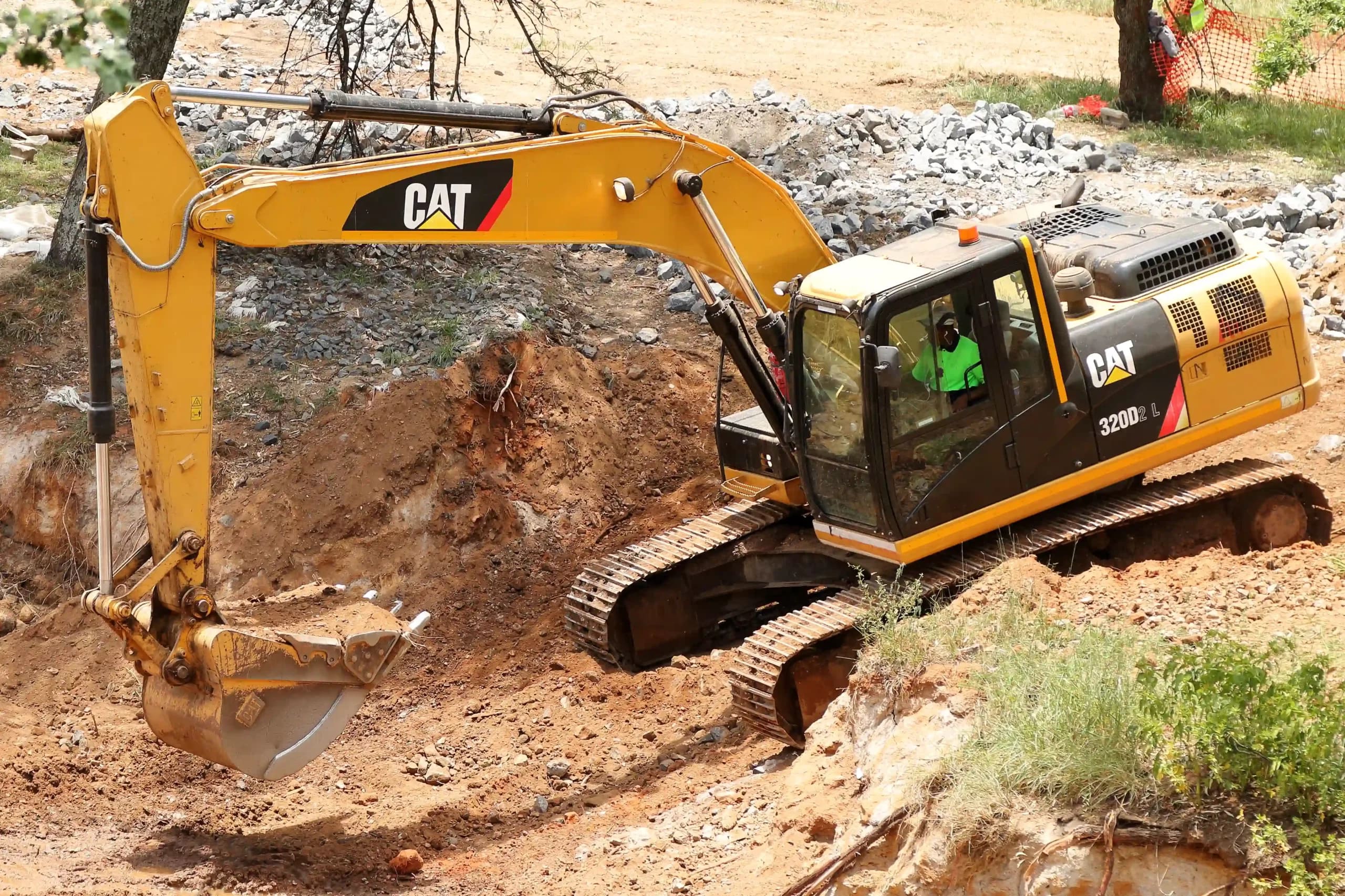
If there is one machine that defines modern construction, it is the excavator. Before foundations are poured, roads are shaped, or buildings begin rising from the ground, excavators are already at work preparing the site for everything that follows.
Their versatility allows them to perform tasks ranging from land clearing and trench excavation to foundation digging and material handling, making them indispensable on almost every major construction project in Uganda.
When you look at Hoima International Airport, excavators have played a central role in preparing the vast construction site.
Thousands of cubic meters of soil have been excavated to create stable foundations for runways, taxiways, terminal buildings, and supporting infrastructure.
Their hydraulic precision allows operators to excavate accurately while maintaining the engineering standards required for an international airport.
The same machines are equally important on infrastructure supporting Uganda’s oil and gas industry.
Along pipeline corridors and associated facilities, excavators dig carefully measured trenches, prepare utility routes, and create drainage systems that protect long-term infrastructure.
Within industrial parks, they excavate foundations for warehouses, factories, and production facilities that will eventually support manufacturing and employment.
What makes excavators remarkable is not simply their size but their adaptability. A single machine can switch between digging, lifting, breaking concrete, clearing vegetation, and loading materials simply by changing its attachments.
This flexibility allows contractors to complete multiple tasks without constantly replacing equipment, improving both productivity and project efficiency.
Bulldozers
Once excavators begin opening up a site, bulldozers quickly take over the demanding task of reshaping the terrain.
Built for raw pushing power, bulldozers move enormous quantities of soil, rock, and debris that would be impossible to handle manually.
Their wide tracks provide stability on uneven ground while their powerful blades allow operators to create level working platforms across large construction sites.
On major road construction projects throughout Uganda, bulldozers remove unsuitable material before creating stable formations that will eventually support layers of gravel, asphalt, and concrete.
At Hoima International Airport, they have helped transform uneven ground into precisely graded surfaces capable of supporting one of the country’s most important aviation facilities. Industrial parks also depend heavily on bulldozers during the early stages of development.
Before factories, warehouses, and processing plants can be constructed, vast areas must be cleared, levelled, and prepared for foundations.
Every pass of the bulldozer brings the site one step closer to becoming a functioning industrial centre capable of supporting investment and employment.
Although bulldozers may appear simple compared to other construction machines, their contribution cannot be overstated.
Without them, preparing large construction sites would require significantly more time, labour, and cost, delaying the progress of every project that follows.
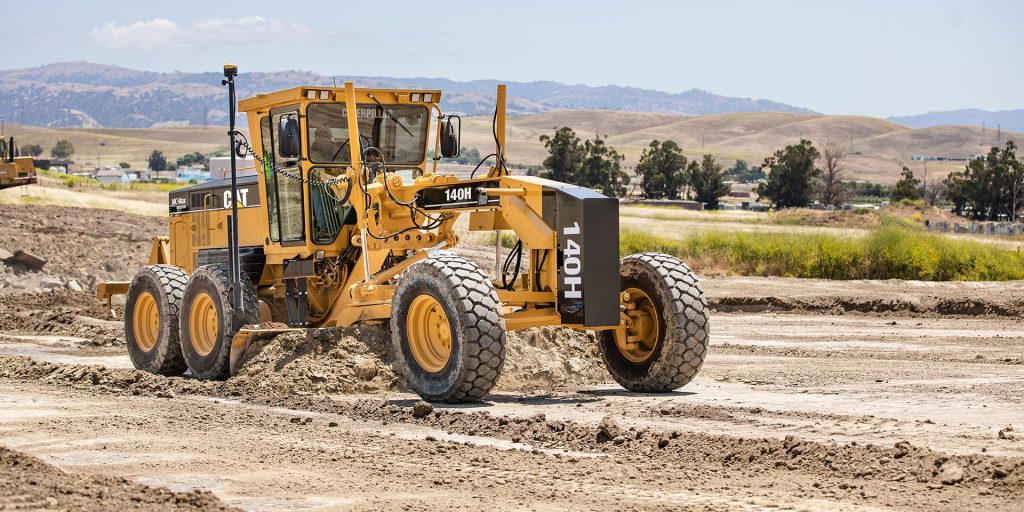
Motor Graders
If excavators are responsible for digging and bulldozers for pushing, motor graders are responsible for achieving precision.
These machines may not attract as much public attention, but they are among the most important pieces of equipment used in road construction and site preparation.
Their long adjustable blades allow operators to create smooth, accurately shaped surfaces that meet strict engineering specifications.
As Uganda continues expanding its national road network, motor graders remain indispensable throughout the construction process.
After bulldozers complete the rough earthworks, graders refine every layer with remarkable accuracy, ensuring roads have the correct alignment, slope, and drainage before compaction begins.
The same precision is required at airport construction sites. Runways demand extremely accurate surface levels to guarantee safe aircraft operations.
Even small deviations can affect performance, making experienced grader operators essential to delivering quality infrastructure.
Beyond roads and airports, motor graders maintain temporary access roads on hydropower projects, industrial developments, and pipeline construction sites.
By creating smooth and reliable haul roads, they allow other machines to operate efficiently while reducing wear and improving site safety.
Wheel Loaders and Dump Trucks
A construction site can have the most experienced engineers, the best designs, and the latest machinery, but if materials are not delivered where they are needed, progress quickly comes to a standstill.
This is where wheel loaders and dump trucks become the unsung heroes of every major infrastructure project.
They may not always attract attention like towering cranes or powerful excavators, yet they keep construction moving every single day.
Wheel loaders are constantly transporting aggregates, sand, crushed stone, soil, and construction materials from one section of a project to another.
Their versatility allows operators to load trucks, manage stockpiles, clear debris, and supply materials to different work zones with remarkable efficiency.
On busy construction sites, these machines rarely remain idle because every stage of construction depends on a continuous flow of materials.
Working alongside them are dump trucks, which serve as the transport backbone of modern construction.
They move thousands of tonnes of excavated soil, gravel, hardcore, and other materials between quarries, borrow pits, stockpiles, and construction sites.
Whether supporting the development of Hoima International Airport, transporting aggregates for national road projects, or supplying materials to Uganda’s growing industrial parks, dump trucks ensure that construction activities continue without costly interruptions.
Imagine constructing a highway without a reliable supply of gravel or attempting to build an airport while waiting for excavated material to be removed manually.
The delays would be enormous. By working together, wheel loaders and dump trucks maintain a steady rhythm that allows contractors to meet demanding project schedules while controlling costs and improving productivity.